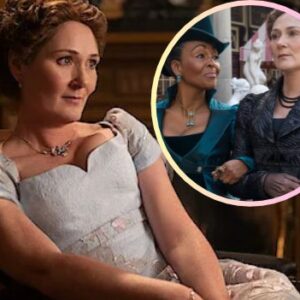
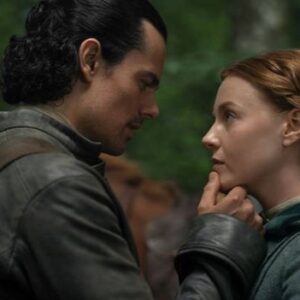
After seeing countless social media ads, I finally gave in and watched Seeking Persephone (2026). The result? A decidedly underwhelming experience. The costumes are passable in places, but the story itself is so difficult to follow that I finished the four-hour miniseries feeling confused, irritated, and thoroughly dissatisfied. This could have been a one-line review, but the show left me with enough unanswered questions to warrant a closer look.
A Romance That Never Quite Makes Sense
The central mystery of Seeking Persephone is simple: Why does the Duke want to marry Persephone in the first place? This question lies at the heart of the entire story, yet the series never offers a convincing explanation.
Online discussions have suggested that the show draws inspiration from the Greek myth of Persephone and Hades, or perhaps from Beauty and the Beast. Neither comparison fits particularly well with what actually unfolds onscreen. The romantic leads have little chemistry, their relationship never develops in a believable way, and the story provides few reasons to understand why they are together at all.
Oddly enough, the Duke seems to have more chemistry with his male best friend, Harry, than with his new wife. I even found myself wondering whether the marriage was merely a cover for a romance between the two men. Their relationship is never explained convincingly either, leaving the supposed romantic dynamics of the series frustratingly unclear.
A Long List of Unanswered Questions
The romance is hardly the only element that makes little sense. The show introduces several characters and storylines without giving them enough context or development.
- What is going on with Persephone’s father? He appears unable to care for his family, but the reason is never explained. During Persephone’s wedding, he even seems to zone out and wander around the chapel. Is he struggling with a mental health condition, or is something else going on? The series offers no clear answer.
- Why is Persephone’s sister Daphne largely forgotten? When Daphne is first introduced, Persephone is the only person who seems to pay attention to her. After that, she practically disappears from the story.
- Why is the youngest sister, Artemis, such a brat? Her characterization relies heavily on the familiar stereotype of the spoiled youngest child, without much nuance to make her interesting.
- What happened between the Duke’s parents? The Duke speaks to his deceased father’s portrait, while his mother behaves in a strangely flirtatious manner with practically everyone at the wedding. Their family dynamic feels peculiar, but the series never adequately explains why.
- Why does the Duke have a scar that occasionally disappears? It is difficult to know whether this inconsistency is intentional or simply a continuity error.
- Does Harry have a life outside the Duke’s castle? He appears to spend most of his time there. When he attempts to leave, things go badly and he returns, leaving his wider circumstances and motivations largely unexplored. At this point, I was practically waiting for the two men to kiss and put an end to the speculation.
- What is the box covered by a tablecloth doing on the breakfast table? It appears repeatedly, and I found myself paying more attention to this mysterious object than to some of the actual plot developments.
- What is the significance of the wolves? Their nightly howling prompts Persephone to sleep in the Duke’s bed, although the show carefully avoids taking their physical relationship any further. Online commentary has attributed the lack of sexual intimacy to the story’s Mormon sensibilities. But are the wolves meant to symbolize something deeper, or are they simply another weak plot device?
The most memorable review I came across on Reddit summed up the experience rather neatly: “It was nice background noise while I reorganized my pantry.”

Honestly, that might be the most accurate description of Seeking Persephone.
The Costumes Are Almost as Disappointing as the Story
Given how little the plot has to offer, it is perhaps unsurprising that the costumes also fall short. The costume designer, Emily Jacobson, has no other credits listed on IMDb, and I would have been perfectly happy if the production had relied more heavily on rented costumes instead. IMDb lists six people under the role of stitcher, suggesting that many of the outfits were custom-made for the series.
The result demonstrates that a production can avoid several common historical-costume mistakes and still fail to create a convincing overall look.

Modern Hairstyles in a Regency-Era Drama
One of the most noticeable problems is the hair. Hairpins do make an appearance, which is a welcome detail, but the hairstyles themselves rarely resemble those of the Regency period. Instead, many of the women sport oversized, elaborate styles that feel distinctly modern.
Persephone’s hair is a particularly obvious example. One outfit features a reasonably convincing bib-front Regency dress, but the hairstyle paired with it looks much more like a contemporary bridal updo than something from the early 19th century.
The problem extends well beyond the leading lady. Her second-oldest sister, Athena, wears a scraggly, untidy updo that bears little resemblance to period hairstyles. Even a visiting pastor’s wife appears with similarly oversized, modern-looking hair.
Persephone’s hairstyles also feature an excessive number of braids. Braided Regency updos certainly existed, but historical fashion illustrations from the 1810s offer far more convincing alternatives. A little more research into the period would have gone a long way toward making these characters look authentic.
Some Gowns Come Close, but Others Miss the Mark
Not every costume is a failure. Persephone’s blue riding habit, which she wears after her marriage, is perfectly serviceable and among the more successful outfits in the series.
Unfortunately, the gowns for the more formal occasions are less convincing.
One ball gown features unusual, distinctly modern-looking seams across the front. The fabric also looks synthetic, giving the dress a cheap appearance that is difficult to ignore. Her lilac gown comes close to working, but never quite gets there.
The men’s clothing fares somewhat better. The Duke’s outfits generally include the right pieces, but the fit of his jackets is poor, particularly around the shoulders. Rather than looking tailored, they appear to be slipping off him.

These are details that can make a significant difference in a period drama. Even when the individual garments are broadly appropriate, poor construction and fit can undermine the entire look.
One Costume Detail Deserves Credit
There is at least one aspect of the show’s wardrobe that deserves praise: the characters wear appropriate outerwear when they venture outdoors.
Unlike some period dramas that have their characters wandering around in short sleeves regardless of the weather, Seeking Persephone makes a point of dressing its characters for outdoor conditions. The cloaks worn by the sisters are a welcome touch.
It is a small detail, but one that demonstrates an awareness of practical historical clothing. Unfortunately, it cannot compensate for the show’s other costume shortcomings.
A Period Drama That Never Finds Its Footing
Ultimately, Seeking Persephone leaves me questioning the creative decisions behind both its storytelling and its costumes. The central romance lacks a convincing foundation, secondary characters are poorly developed, and numerous details are introduced without explanation. Meanwhile, the wardrobe occasionally gets the basics right but repeatedly undermines itself with questionable hairstyles, awkward tailoring, and gowns that look more modern than Regency.

The series is not entirely without merit, and some of its costumes are perfectly adequate. But neither the story nor the visual presentation offers enough to make the four-hour commitment feel worthwhile.
Need something to play in the background while you clean the house? Then seek out Seeking Persephone! Just do not expect the romance or the costumes to demand too much of your attention.
Source: Compiled from various sources