arrow_forward_ios
Read more
00:00
00:01
01:31
Justin Bieber delivers an emotional rendition of “Hallelujah” during the fictional FIFA World Cup 2027 halftime show, offering a performance centered on simplicity, vocal expression, and the enduring appeal of one of modern music’s most celebrated songs. Accompanied by a live orchestra and choir, Bieber’s interpretation transforms the imagined stadium into a sea of lights as fans sing along, creating a memorable musical moment that focuses on the song rather than elaborate production.
Originally written by Canadian singer-songwriter Leonard Cohen, “Hallelujah” first appeared on his 1984 album Various Positions. Although the song did not become an immediate commercial success, it gradually gained recognition through numerous cover versions over the following decades. Among the most influential interpretations was Jeff Buckley’s 1994 recording, which introduced the song to a new generation of listeners and helped establish it as a modern classic. Since then, artists across pop, country, gospel, classical, and contemporary music have recorded their own versions, making it one of the most frequently covered songs in popular music.

Part of the song’s lasting appeal comes from its layered lyrics and emotional openness. Cohen combined biblical references with reflections on love, heartbreak, faith, and resilience, allowing listeners to find their own meaning within the words. Because of that versatility, “Hallelujah” has become a popular choice for concerts, television specials, memorials, and other significant public events where emotion plays an important role.
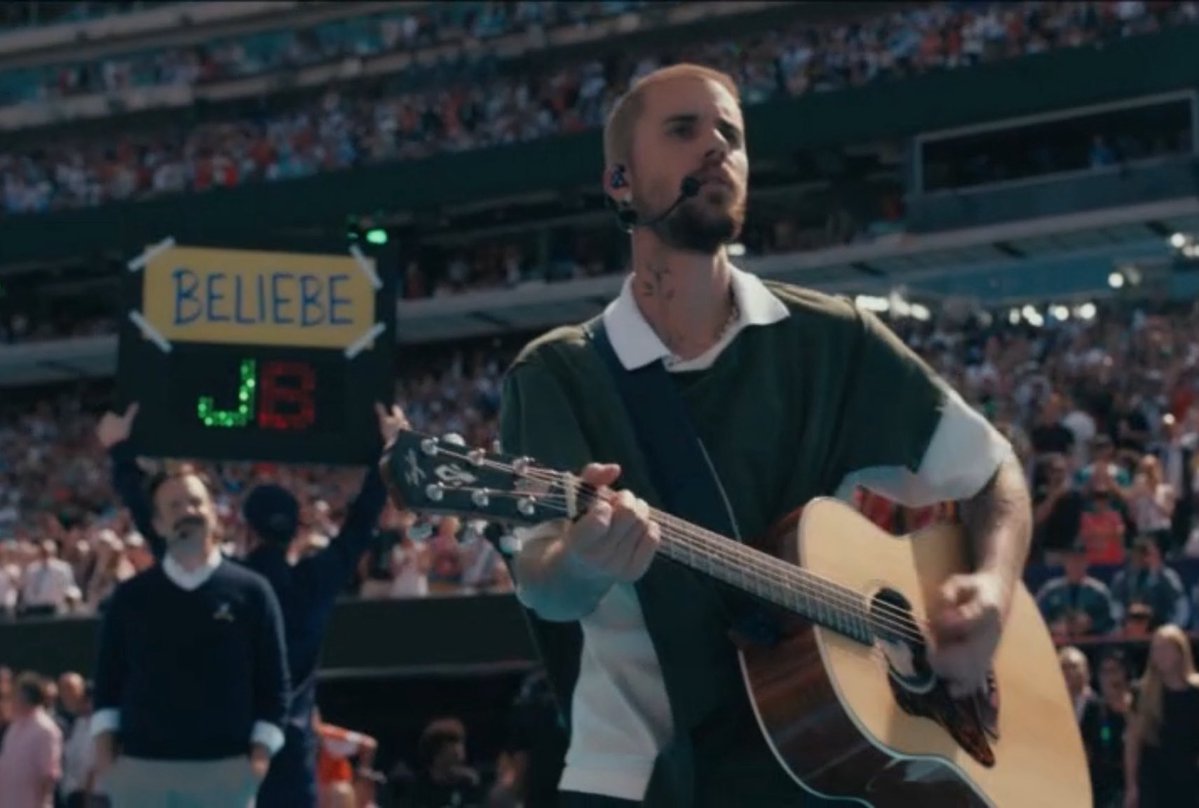
In this fictional World Cup halftime performance, Bieber approaches the song with restraint rather than attempting to dramatically reinvent it. His vocals remain clear and controlled throughout the opening verses, allowing the lyrics to take center stage. As the orchestra gradually builds and the choir joins in, the arrangement expands naturally without overwhelming the song’s intimate character.
The orchestral accompaniment gives the performance a cinematic atmosphere while maintaining the simplicity that has always been one of the song’s greatest strengths. Instead of relying on heavy visual effects or fast-paced staging, the imagined production emphasizes musicianship, creating space for Bieber’s voice to carry the emotional weight of the performance. The choir adds richness during the chorus, while the orchestra enhances the gradual progression from quiet reflection to a more powerful conclusion.
One of the defining images of the fictional performance comes from the audience itself. As thousands of spectators illuminate the stadium with their phone lights and quietly sing along, the focus shifts from a solo performance to a shared musical experience. The visual complements the message often associated with “Hallelujah,” highlighting music’s ability to bring together people from different backgrounds through a familiar and meaningful song.
Following the performance, social media reactions in this fictional scenario praise Bieber’s vocal delivery, stage presence, and respectful interpretation of a well-known classic. Many describe it as one of the standout moments of the halftime show, noting that its emotional impact comes not from spectacle but from thoughtful musical execution. By pairing a timeless composition with a restrained performance style, the imagined World Cup appearance illustrates why “Hallelujah” continues to resonate with audiences decades after it was first written.
Source: Compiled from various sources