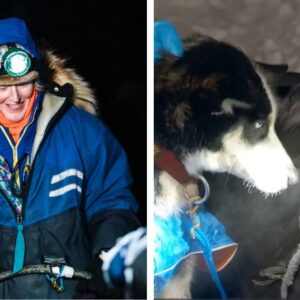
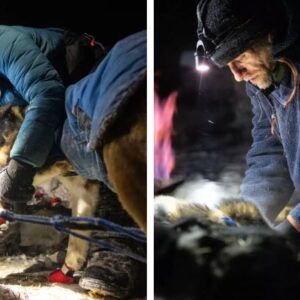
Riches and paid appearances haven’t followed Jessie Holmes since he won the world’s most famous sled dog race, the Iditarod, last year.
He doesn’t mind.
A carpenter and a former cast member of National Geographic’s reality show “Life Below Zero,” Holmes has instead been content to return to his austere, hand-built homestead in the wilderness near the continent’s tallest mountain. His life is solitary and frugal. His closest neighbors are 30 miles away.
“There’s a lot of things that can happen in your life once you win the Iditarod,” Holmes told The Associated Press in an interview before this year’s race. “You could become a real big deal, or you could just go back out in the bush and get right back to work, you know? And that’s what I did.”
Holmes took off Sunday along with 33 other competitive mushers in an effort defend his title in the rigorous Iditarod Trail Sled Dog Race, the 1,000-mile journey from Willow to Nome. A day later he was in the lead.
The winner is expected to reach the finish line around March 17 after traveling over two mountain ranges, along the frozen Yukon River and on the treacherous ice of the Bering Sea on Alaska’s western coast.

Dreams of becoming a mountain man
Mushing was foreign to Holmes growing up in Odenville, Alabama, but he had an affinity for hard-luck dogs.
“I was always getting in trouble for bringing dogs home that I found on the streets and hiding them out in the woods and feeding them out of the fridge,” he said.
His life found a calling after he saw the 1972 Robert Redford film “Jeremiah Johnson,” based partly on the legend of a real-life 19th century mountain man.
At age 18, he set out to make that a reality, jumping on passing freight trains to go north. He eventually settled in Montana, where he hooked his hound dog up to a sled to help pull equipment during the winter.
He still had no clue there was a thriving competitive mushing lifestyle until he moved farther north, to Dawson City, in Canada’s Yukon Territory, after the turn of the century.
“I thought, this is exactly what I want to do,” Holmes said.

A rough introduction to competitive mushing
He moved two years later to Alaska, living off the land in a village on the Yukon River, near the Canada border. He used his dogs to haul wood and water and to assist him while hunting, fishing and trapping.
Competitive mushing gnawed at him. “I could be really good at this,” he thought. “I think I’m really good with dogs. I should race.”
He learned some hard lessons in his first race. He finished last in a 200-mile competition in Fairbanks in 2006 and realized he needed faster dogs. He moved to a cabin without running water or electricity with nearly 40 dogs, regrouped and began to race again in 2012.

A reality show and Iditarod success
He also joined the cast of “Life Below Zero,” documenting the daily struggles of living in remote parts of Alaska. He appeared in 132 episodes over eight seasons, with pay that allowed him to buy better dog food and equipment. He eventually also bought the land near Denali National Park where he homesteaded.
The hard work of mushing his dogs in the backcountry paid off when he entered his first Iditarod in 2018. He came in seventh, earning rookie of the year honors and a $26,000 check.
He’s been in every Iditarod since, placing in the top 10 all but two years. Last year’s title came with a check for just over $57,000. He described the win as “magical” and gave all the credit to his dogs, which he called his family.

In the Iditarod’s heyday, when it was a regular feature on ABC’s “Wide World of Sports,” winning mushers — especially those with multiple titles — were able to capitalize on their fame with big endorsements and sponsorships, some pocketing $250,000 a year.
But waning financial support, due in part to a animal rights group targeting national sponsors, has shrunk the purse while inflation is stifling young mushers trying to make a go of it. This year a Norwegian billionaire, Kjell Rokke, has provided additional backing as he mushes in a new amateur or “expedition” category.
Pressure to repeat as champ
Holmes does have a sponsor — a local auto-repair chain. But he hasn’t done paid appearances or events, and his income now primarily comes from race winnings and breeding dogs. And even though Rokke’s contribution is boosting prize money this year, Holmes said he’s not in favor of amateurs being on the trail.
“I don’t really feel like it aligns with the spirt of the race,” he said. “I just really don’t want to say too much because I don’t want to dig a hole for myself, but I don’t mind saying that I’m not a fan of it.”
In a social media post, he said he logged some 4,500 miles training with his dogs this winter.
“Deep snow. Ferocious winds. 40 below and colder,” he wrote. “But that’s nothing new to us out here. Instead of letting it break us, we let it sharpen us.”

The self-imposed stress of repeating as champion is burning at him. He calls this year’s race the most important of his career. Many mushers have won multiple Iditarod titles, but only two — Susan Butcher and Lance Mackey — won their second title the year after getting their first.
“That’s hard to put that on yourself because you got to live with that pressure every day,” Holmes told the AP. “And if I do not make it, it is going to absolutely crush me.”
Yes, I want to sign up for the ADN’s Iditarod newsletter for the latest updates and coverage from the trail
Source: adn.com