The medical drama The Pitt has drawn attention not only for its evolving cast and hospital-based storytelling, but also for how it adjusts its content in response to real-world events. One notable example came in Season 2, when a politically sensitive scene was altered during production following developments in real life that made the original version potentially more controversial.
The episode in question featured a storyline involving Immigration and Customs Enforcement (ICE) agents bringing an injured Latina woman into the emergency department. The narrative escalated tensions inside the hospital, eventually leading to the arrest of Nurse Jesse, played by Ned Brower, after he intervened in the situation. According to production notes and comments from the creative team, the original version of the scene was intended to include a physical confrontation between Jesse and the officers, heightening the drama of the moment.

However, that sequence was ultimately removed. Series star and producer Noah Wyle explained that the decision came after real-world violent events involving individuals named Renée Good and Alex Pretti, which shifted the tone of how such content might be received. The creative team reassessed the material and decided that a more restrained approach would be more appropriate given the sensitivity of the situation. Instead of emphasizing confrontation, the revised scene leaned into tension and ambiguity, allowing the situation to remain unresolved in a more grounded way.
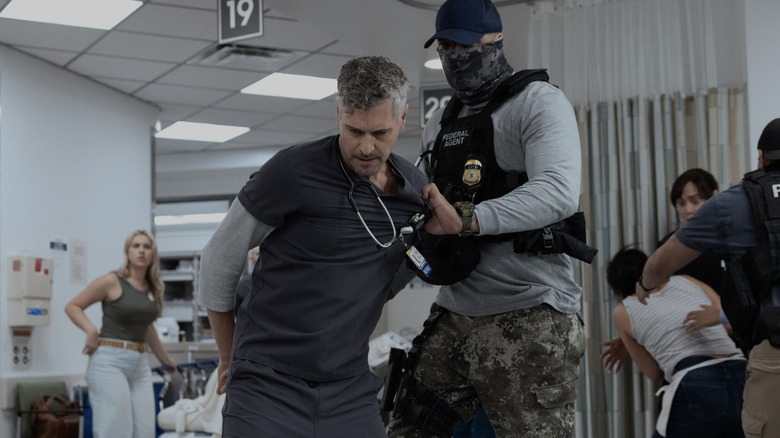
Wyle described the creative adjustment as a deliberate choice to avoid overstating the moment, emphasizing a “less is more” approach in storytelling. Rather than pushing the scene toward explicit conflict, the writers opted to let the discomfort and uncertainty speak for themselves. This decision reflects a broader philosophy within The Pitt, which often presents ethically complex situations from the perspective of hospital staff without fully resolving political or systemic debates on screen.
The show’s creator, R. Scott Gemmill, has previously described such storylines as intentionally open-ended. He has referred to them as a kind of “Rorschach test,” where viewers interpret the events based on their own perspectives. In this approach, the series avoids taking a strongly didactic stance and instead focuses on presenting institutional pressure, medical urgency, and human reactions within the hospital environment.
Gemmill has also noted that the series primarily follows the perspectives of doctors and nurses rather than fully exploring the backgrounds of patients or external authorities involved in cases. This narrative limitation shapes how controversial topics are portrayed, keeping the focus on immediate professional and ethical challenges inside the ER rather than broader political commentary.

Producer John Wells has echoed this approach, emphasizing that the goal is not to lecture audiences but to reflect complexity. According to him, the network’s guiding principle has been to maintain balance rather than promote a specific viewpoint, especially when dealing with sensitive or divisive subject matter. This stance allows The Pitt to engage with real-world issues while maintaining narrative flexibility.
The Season 2 adjustment illustrates how television production often intersects with external events in unpredictable ways. Writers and producers must navigate not only storytelling goals but also audience perception and real-time cultural context. In this case, restraint became the chosen direction, shaping a scene that ultimately relied more on tension and implication than explicit confrontation.
Source: Compiled from various sources